Soft Summer vs Soft Autumn: How to Tell the Difference
Are you trying to determine whether you’re Soft Summer vs Soft Autumn? Both look lovely in soft, refined shades. So how do you tell them apart?
I want to preface this guide by saying that I think color analysis seasons aren’t rigid categories. I like to think of the twelve seasons as a spectrum rather than individual buckets. But if you’re trying to figure out where you best align, then let’s figure out if you’re a Soft Summer or a Soft Autumn!
What are Warm Colors vs Cool Colors?
The fundamental distinction between Soft Summer vs Soft Autumn goes back to color theory in art, warm colors vs cool colors. I think this post by Just Paint handles the idea really well.
The idea in art is that, in general, the primary and secondary colors of red, orange, and yellow are considered “warm” colors and the the primary and secondary colors of green, blue, and magenta are considered “cool” colors.
This idea of color “temperature” is just a way of categorizing colors we can see, based on how they make us feel. Red/orange/yellow feel to people more like a warm sunny day whereas green/blue/magenta feel more like cool water or the night sky.
So when we say warm vs cool colors or warm vs cool tones, or the temperature of colors, what we’re really talking about is how much red-orange is in a color compared to how much green-blue is in a color. For example, a yellow with more green in it is cooler than yellow with more red in it.
This applies to your skin and seasonal color palette as well, and is a good way to differentiate if you are Light Spring vs Light Summer.
Your Skin’s Temperature in Color Analysis
Color temperature is the key difference between Soft Summer vs Soft Autumn.
Soft Summer has cool undertones (pink, blue, mauve) while Soft Autumn has warm undertones (golden, peachy, warm beige).
Both seasons share the same primary characteristic of mutedness. Both look best in colors with gray mixed in, creating that sophisticated gentle quality. But the temperature of those muted colors determines your season.
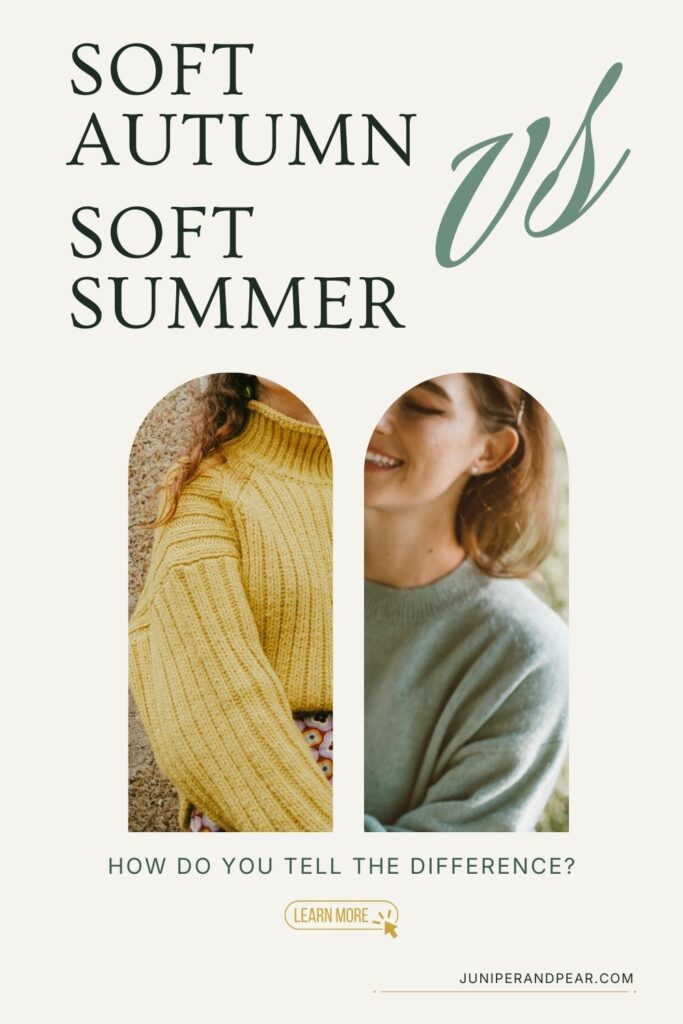
Understanding Soft Summer vs Soft Autumn
Soft Summer
Soft Summer is primarily characterized by mutedness/softness first, with secondary coolness. Soft Summers look best in:
- Muted, cool colors with pink or blue undertones
- Colors like dusty rose, soft teal, sage blue, muted mauve, cool taupe
- Medium-value colors (that is, not too light, not too deep)
Think of Soft Summer as the palette of a misty coastal morning, everything is muted and touched with dewy coolness.
Soft Autumn
Soft Autumn is primarily characterized by mutedness/softness first, with secondary warmth. Soft Autumns look best in:
- Muted, warm colors with golden or peachy undertones
- Colors like dusty peach, soft olive, muted warm teal, warm taupe, soft camel
- Medium-value colors (that is, not too light, not too deep)
Think of Soft Autumn as the palette of an autumn morning in fog with the sun just beginning to break through, everything is muted and touched with gentle warmth.
Side-by-Side Color Comparisons
The best way to understand the difference between Soft Summer vs Soft Autumn is to compare the temperature of similar muted colors:
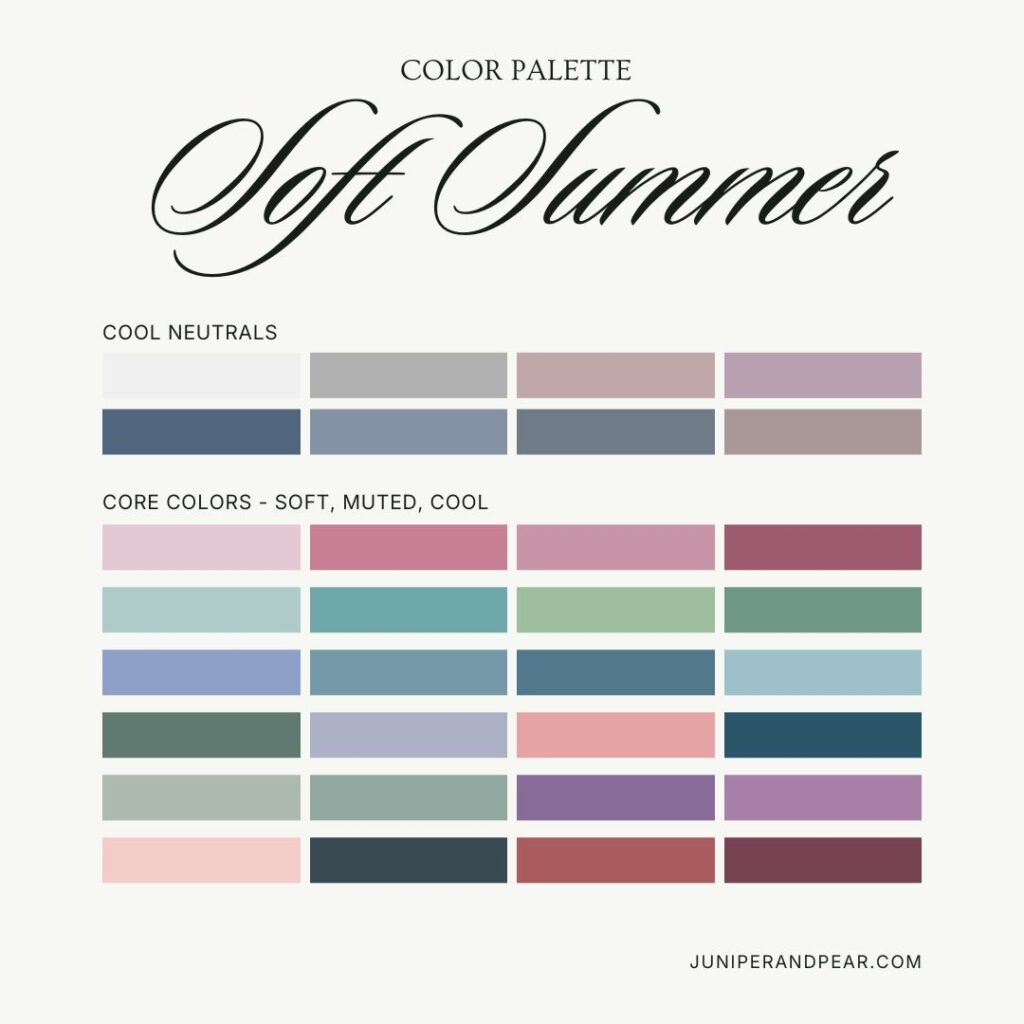
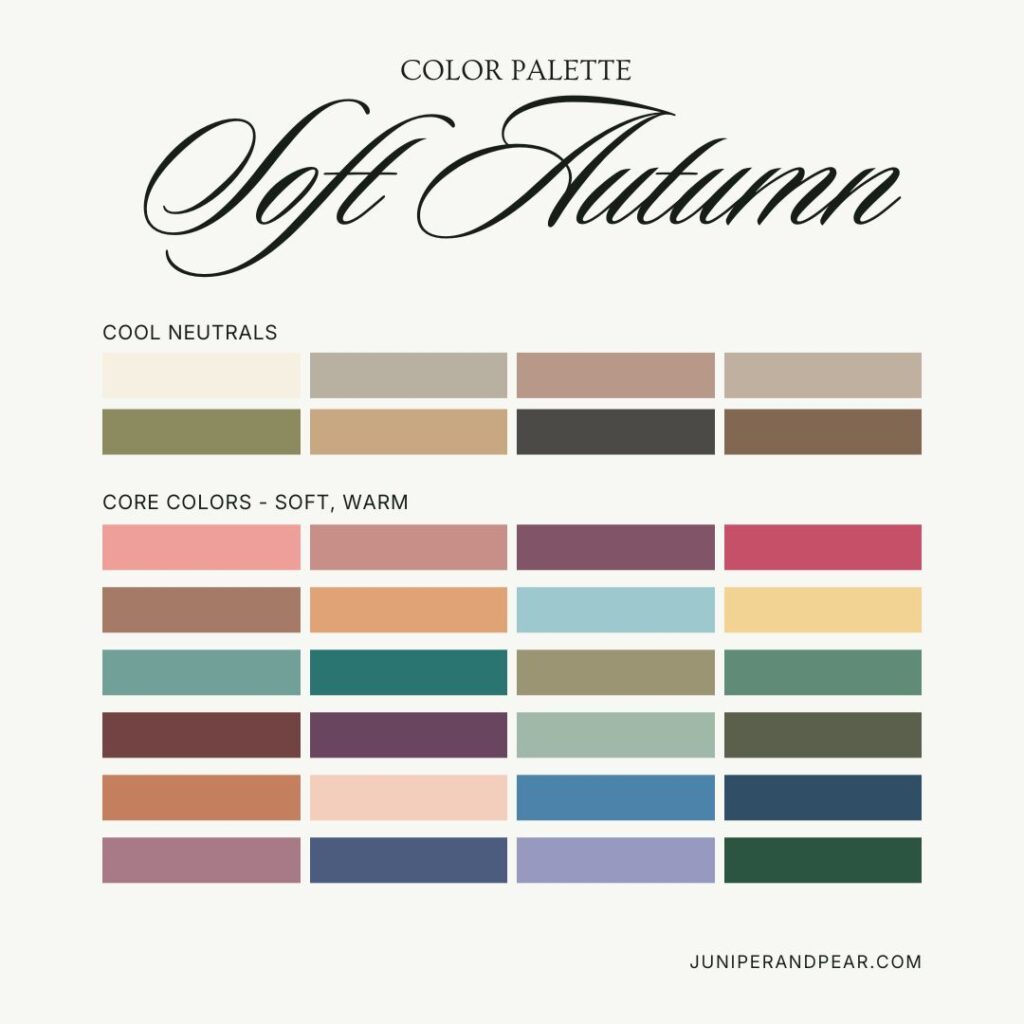
Neutrals
Soft Summer has soft white, cool gray, blue-gray, soft cocoa, while Soft Autumn has cream, warm gray, greige (warm), soft camel.
Roses/Pinks
Soft Summer has dusty rose, cool mauve-pink, soft raspberry, while Soft Autumn has dusty peach, rose-brown, soft salmon.
Teals
Soft Summer has soft cool teal, blue-green, while Soft Autumn has muted warm teal (warm-leaning), warm sea green.
Greens
Soft Summer has sage blue, soft cool sea green, muted jade, while Soft Autumn has soft olive, warm sage green, khaki green.
Browns/Taupes
Soft Summer has rose-taupe, mauve-taupe, cool taupe, while Soft Autumn has warm taupe, mushroom, and warm rosey brown.
Purples
Soft Summer has mauve, soft plum, heather, while Soft Autumn has soft warm plum, muted aubergine.
How to Test for Soft Summer vs Soft Autumn
Test 1: The Dusty Rose vs Dusty Peach Test
What you need: A dusty rose (cool muted pink) item and a dusty peach (warm muted pink) item of clothing or fabric.
What to do: Hold each color near your face in natural daylight and observe carefully
Soft Summer result: The dusty rose makes your skin look more even and clear. The dusty peach makes you look sallow, yellow, or somehow off.
Soft Autumn result: The dusty peach makes your skin look warm and clear. You look even. The dusty rose makes you look gray, washed out, or tired.
Test 2: The Soft Teal Test
What you need: Find two versions of soft teal, one that leans cool (more blue) and one that leans warm (more golden-green).
What to do: Hold each color near your face in natural daylight and observe carefully.
Soft Summer result: The cool-leaning teal makes you look clear and even. The warm-leaning teal makes you look off or sallow.
Soft Autumn result: The warm-leaning teal makes you look lovely. The cool-leaning teal makes you look gray or tired.
Test 3: The Olive vs Sage Blue Test
What you need: A soft olive green item (warm) and a sage blue item (cool).
What to do: Hold each color near your face in natural daylight and observe carefully.
Soft Summer result: Sage blue looks pretty on you. Soft olive makes you look muddy or tired.
Soft Autumn result: Soft olive looks earthy and pretty. Sage blue makes you look washed out or gray.
Test 4: The Metal Test
What you need: Find at least one piece of gold jewelry and one piece of silver.
What to do: Compare how you look in gold vs silver jewelry
Soft Summer result: Silver, platinum, or white gold looks natural on you. Yellow gold can look brassy or wrong.
Soft Autumn result: Gold, rose gold, or brass looks warm and pretty. Silver can look stark or too harsh.
Test 5: The Foundation Test
Soft Summer: Pink-based, neutral-cool, or soft beige foundations with cool undertones look more natural on you.
Soft Autumn: Golden, peachy, or warm beige foundations wear more easily on you.
Common Confusion Points
Hair color doesn’t determine your season, skin undertone does. You can have ash-brown hair and be a Soft Autumn if your skin has warm undertones.
Because both palettes are muted, some colors (especially certain neutrals and teals) might work for both. (Again, seasonal color palettes work more on a spectrum rather than rigid buckets.) However, when you compare distinctly warm vs cool versions, one will clearly make your skin look a bit better than the other and serve as your home season.
Soft Autumns can wear warm gray beautifully. The question isn’t whether you can wear gray, but whether cool gray or warm gray looks better.
Styling Differences between Soft Summer vs Soft Autumn
A Soft Summer might wear:
- Dusty rose blouse with cool gray trousers
- Soft teal dress with silver accessories
- Mauve cardigan over soft white top
- Sage blue with rose-taupe
A Soft Autumn might wear:
- Dusty peach blouse with warm taupe trousers
- Warm muted teal dress with gold accessories
- Soft olive cardigan over cream top
- Warm sage with mushroom brown
Makeup Differences
Soft Summer Makeup
- Foundation: Cool, pink, neutral-cool, or soft cool beige
- Blush: Dusty rose, soft mauve-pink, muted raspberry
- Lipstick: Dusty rose, muted mauve, soft berry, rose-nude
- Eyeshadow: Soft teal, muted purple, cool taupe, sage blue
- Eyeliner/Mascara: Soft brown, cool gray, soft navy
- Nails: Soft dusty rose, soft teal, periwinkle, slate blue
Soft Autumn Makeup
- Foundation: Warm, golden, neutral-warm, or soft warm beige
- Blush: Dusty peach, soft coral, warm rose-brown
- Lipstick: Dusty peach, muted coral, soft salmon, warm nude
- Eyeshadow: Soft olive, warm taupe, dusty peach, sage
- Eyeliner/Mascara: Soft brown, warm charcoal, soft olive
- Nails: Dusty peach or rose, muted teal, warm periwinkle
When You Might Be On The Border
Some people are close to the border between Soft Summer and Soft Autumn. You might be borderline if:
- You’re a Soft Summer who can borrow some very soft, muted warm neutrals like cream.
- You’re a Soft Autumn who can borrow some very soft, muted cool neutrals like soft white.
Again, think spectrum not buckets. However, even borderline cases will have a clear home base in one season when comparing the signature colors like dusty rose vs dusty peach.
What If You’re Neither?
If both Soft Summer and Soft Autumn colors seem wrong, consider:
- True Summer if you need more coolness and less mutedness.
- True Autumn if you need more warmth and less mutedness.
- Light Summer if you need lighter colors than Soft Summer.
- Deep Autumn if you need deeper colors than Soft Autumn.